A Statistical Investigation of Protostellar Outflow v.s. Magnetic Field Alignment
My current work spans intermediate scales (~1,000 au–0.1 parsec) to constrain the relative dynamical importance of magnetic fields in low-mass and massive star formation. Trends in protostellar outflow alignment provide key insights into the dynamical importance of magnetic fields in forming stars and circumstellar disks (e.g., Green et al. 2025, Kong et al. 2019). Using both new and archival JWST NIRCam images, we’re identifying outflows in both low-mass and massive star-forming regions and characterizing their orientations. We’re assessing trends in the degree of alignment between these outflows and the core-scale magnetic field, inferred from archival dust polarization data, to investigate the relative strength and the role of magnetic fields in different environments and mass regimes.
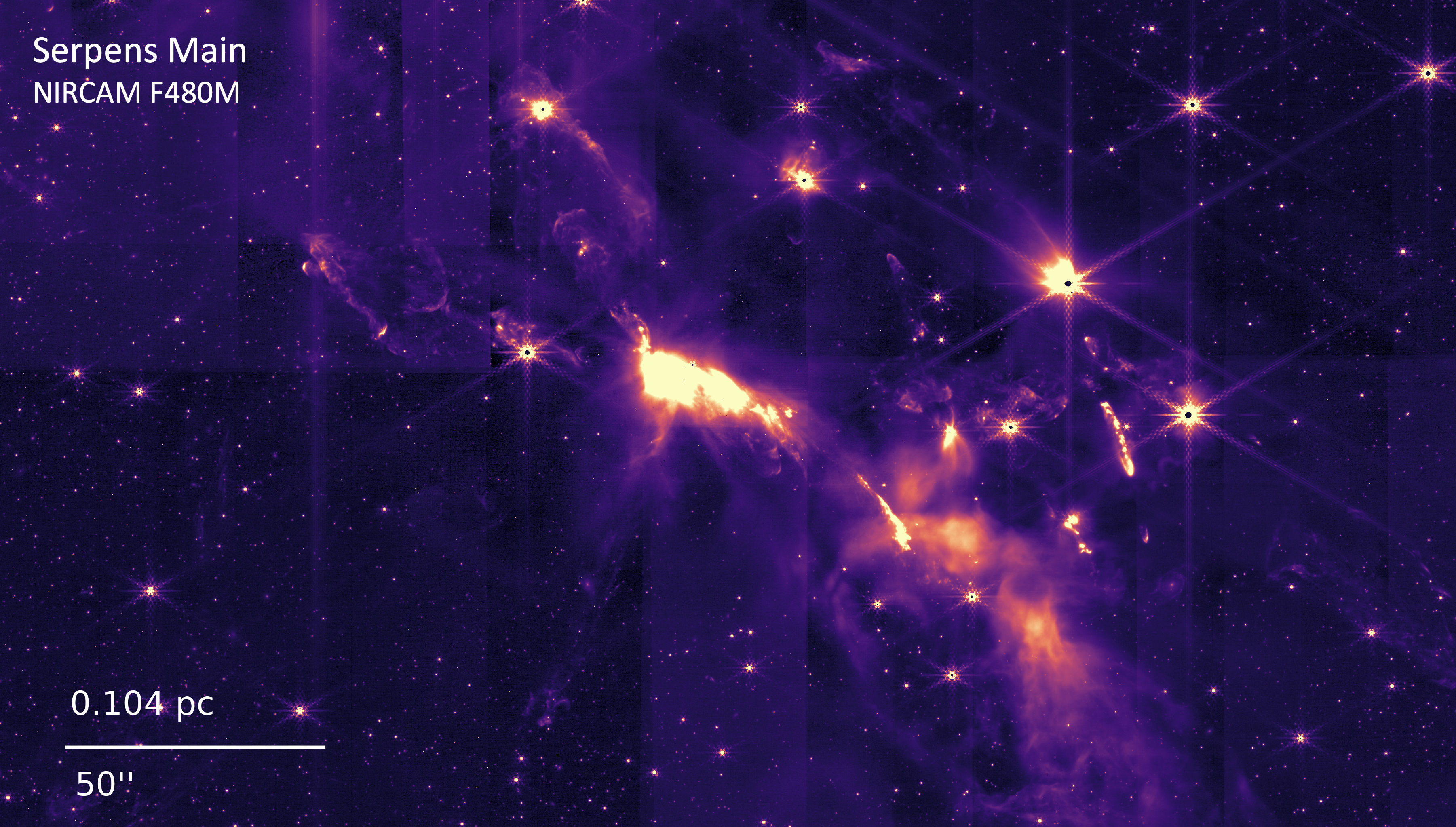
JWST NIRCam F480M-filter image of the Serpens Main star-forming region (Telkamp et al. 2026, in prep.). Multiple outflows are visible via shocked H2 and other outflow tracers in this band. (Note: while individual outflows are characterized on scales of ~1,000 au–0.1 pc, the JWST NIRCam data span larger fields of view (up to several pc), allowing us to survey multiple outflows and their surrounding environment in a single pointing.)
As part of this project, I’ve developed a Python package with interactive tools to identify outflow structures and characterize outflow orientations and tested it on JWST NIRCam and ALMA data. I plan to release this package publicly on GitHub with GUI-based outflow analysis tools, documentation, and tutorials.