research
A multi-scale investigation of star formation across the mass spectrum
Star formation is a complex, multi-scale process traditionally studied in two regimes: low-mass and massive stars, divided at approximately 8 solar masses. Although massive stars only comprise ~1% of the stellar population, their high-energy output and collapse into supernovae have a profound impact on galactic ecosystems. Yet, due to their extreme nature and rarity, a key question remains: do the observed differences between massive and low-mass stars reflect fundamentally distinct formation mechanisms, or is massive star formation simply a scaled-up version of the low-mass star formation process? My research uses data from telescope facilities spanning infrared (IR) to millimeter wavelengths to study star formation across a range of physical scales, working towards a more unified picture of star formation across the mass spectrum.
Core and Environment scale (~10,000 au – 1 pc)
The SOFIA Massive (SOMA) Star Formation Survey. V. Clustered Protostars
Published Paper · AAS Nova: Selections from 2025
This project utilized ~5–500 μm (Mid/Far-IR) data to investigate the initial conditions required for massive stars to form by examining protostars and their host environments on scales of ~10,000 au–1 parsec as part of the SOFIA Massive (SOMA) Star Formation Survey (De Buizer et al. 2017; Liu et al. 2019, 2020; Fedriani et al. 2023; Telkamp et al. 2025). The SOMA survey used the SOFIA-FORCAST instrument to observe a large sample of intermediate- and high-mass protostars across a wide range of environments and evolutionary stages to test predictions of massive star formation models. SOMA Paper V (Telkamp et al. 2025) investigated protostars forming in "clustered" environments. Using SOFIA-FORCAST observations in conjunction with archival Spitzer and Herschel data, we identified 34 protostars in 7 regions of clustered star formation and performed spectral energy distribution (SED) fitting to derive their properties. Synthesizing results from the entire SOMA survey of over 70 protostars across different environments, we found massive stars forming under diverse conditions, with no evidence that they require their environment to meet a minimum mass surface density ($\Sigma_{cl}$) threshold. This contradicts models that predict that massive stars, unlike their low-mass counterparts, require a minimum $\Sigma_{cl}$ to form.
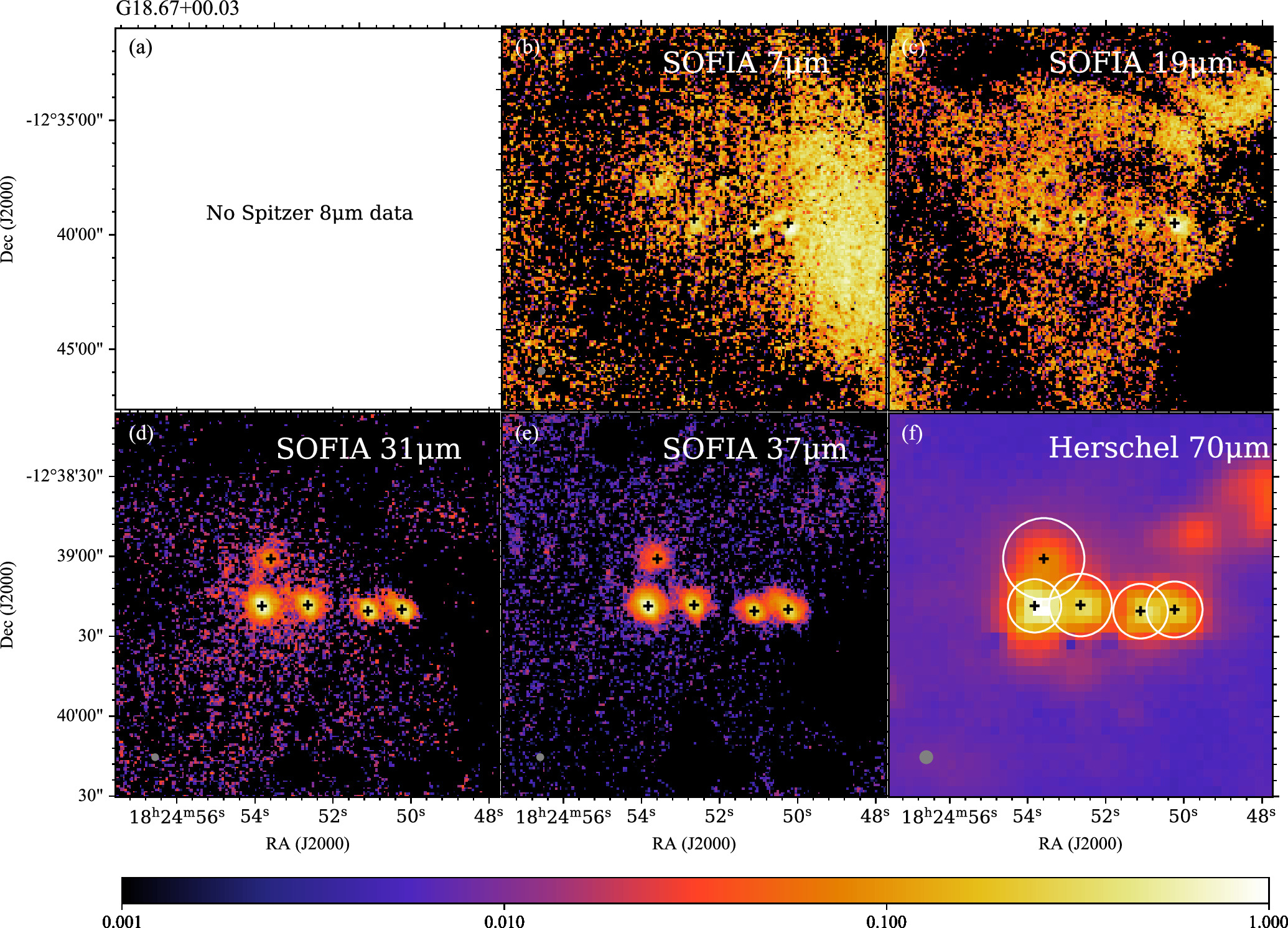
Multiwavelength images of the AFGL 5180 star-forming region with the facility and wavelength given in the upper right of each panel (Telkamp et al. 2025). Black plus signs represent the protostar positions, white circles represent the apertures used for photometry, and the color map indicates the relative flux intensity compared to that of the peak flux in each image panel.

As part of this work, I led the development of version 2.0 of sedcreator (Fedriani et al. 2023, Telkamp et al. 2025), an open-source Python package that automates the photometry and SED building and fitting process for large protostellar samples. Version 2.0 expanded sedcreator's capabilities to simultaneously analyze any number of protostars in clustered regions, where contamination from neighboring sources must be accounted for.
Telkamp et al. (2025) was featured in AAS Nova's Selections from 2025, a series highlighting some of the most-downloaded articles published in AAS journals that year.
Intermediate (outflow) scale (~1,000 au – 0.1 pc)
A Statistical Investigation of Protostellar Outflow v.s. Magnetic Field Alignment
My current work spans intermediate scales (~1,000 au–0.1 parsec) to constrain the relative dynamical importance of magnetic fields in low-mass and massive star formation. Trends in protostellar outflow alignment provide key insights into the dynamical importance of magnetic fields in forming stars and circumstellar disks (e.g., Green et al. 2025, Kong et al. 2019). Using both new and archival JWST NIRCam images, we’re identifying outflows in both low-mass and massive star-forming regions and characterizing their orientations. We’re assessing trends in the degree of alignment between these outflows and the core-scale magnetic field, inferred from archival dust polarization data, to investigate the relative strength and the role of magnetic fields in different environments and mass regimes.
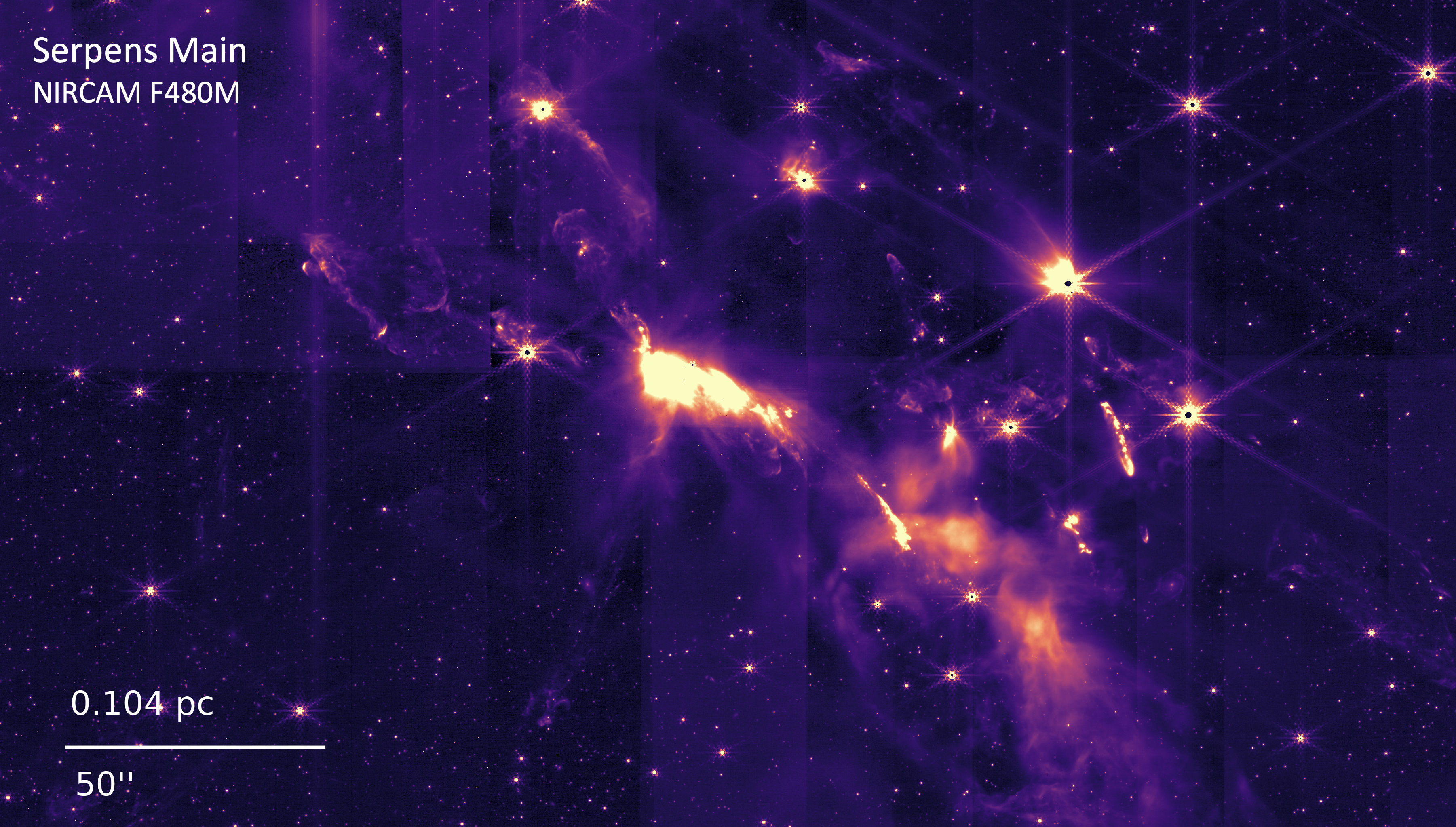
JWST NIRCam F480M-filter image of the Serpens Main star-forming region (Telkamp et al. 2026, in prep.). Multiple outflows are visible via shocked H2 and other outflow tracers in this band. (Note: while individual outflows are characterized on scales of ~1,000 au–0.1 pc, the JWST NIRCam data span larger fields of view (up to several pc), allowing us to survey multiple outflows and their surrounding environment in a single pointing.)
As part of this project, I’ve developed a Python package with interactive tools to identify outflow structures and characterize outflow orientations and tested it on JWST NIRCam and ALMA data. I plan to release this package publicly on GitHub with GUI-based outflow analysis tools, documentation, and tutorials.
Innermost (disk) scale (~10–100 au)
An Archival ALMA Survey of Disks around Massive Protostars
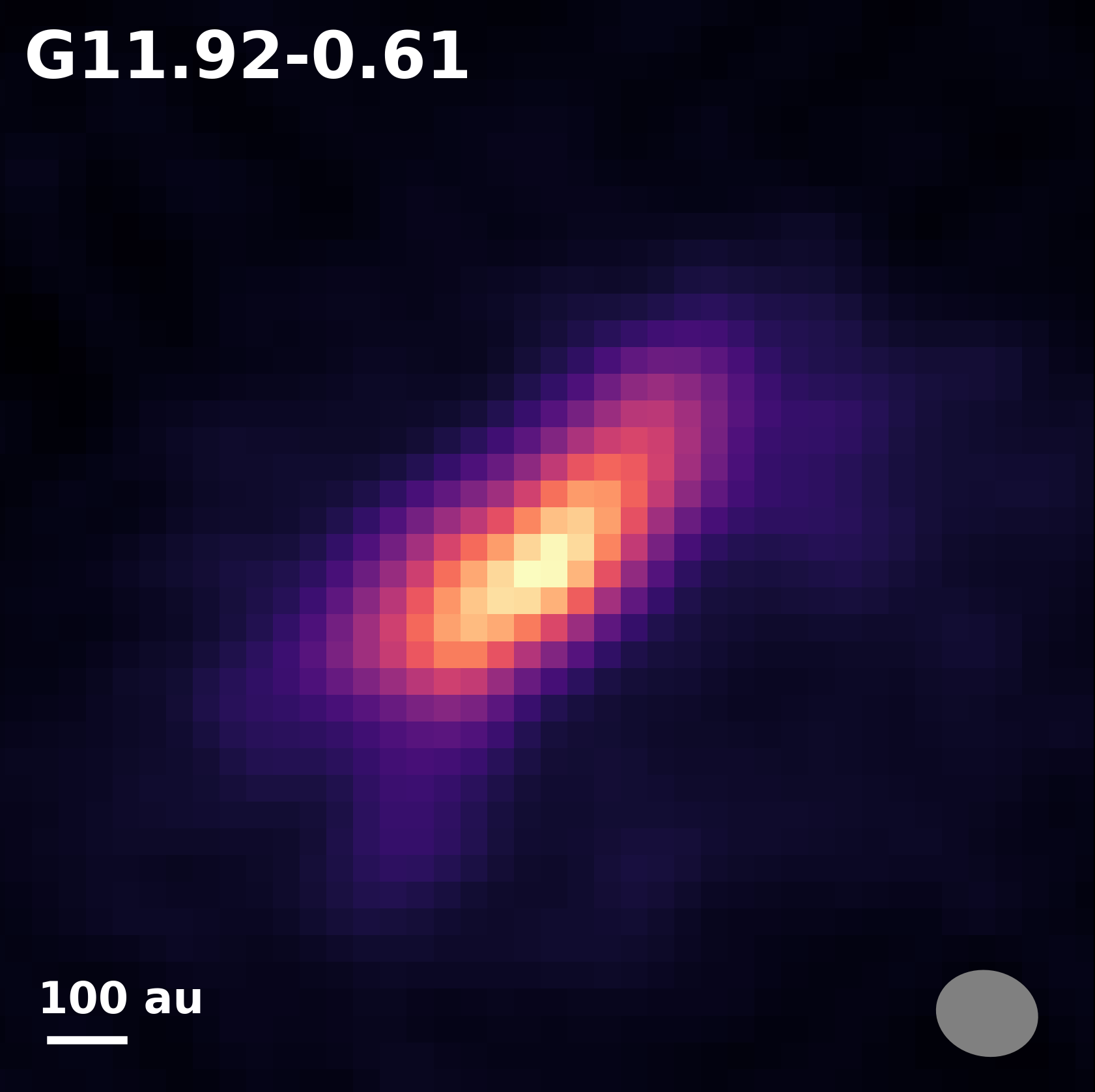
Example ALMA Band 6 continuum image from the Telkamp et al. (2026, in revision) sample, zoomed in on a disk in the G11.92-0.61 protocluster. A 100 au scale bar and a gray ellipse representing the beam are shown.
This project investigated the innermost scales where disks form (~10–100 astronomical units) to study accretion and formation mechanisms of massive star formation by searching for signatures of either a core accretion process similar to how low-mass stars form, or competitive accretion in dense protoclusters. In this study, we performed a systematic archival analysis of some of the highest-resolution (≲ 50 milliarcseconds) ALMA Band 6 (~1.3 mm) continuum observations to date. We identified and analyzed >100 protostellar disk candidates in 16 diverse massive star-forming regions and performed 2D Gaussian fitting to measure their continuum fluxes and derive disk properties. To connect this information to larger spatial scales and constrain additional properties of the protostellar systems, we also performed complementary Mid/Far IR SED fitting. Synthesizing what we learned from these multi-scale, multiwavelength data sets, we examined properties of these protostars and their disks in the context of massive star formation model predictions. This publication (Telkamp et al. 2026) has been submitted to The Astrophysical Journal; revisions are in progress.